
In the span of 5 years, Robby Spring’s mother and sister were both diagnosed with breast cancer. When her sister was diagnosed with breast cancer in 2023, Robby asked for an ultrasound and mammogram, which resulted in Robby also being diagnosed with breast cancer in May 2023. Today, nearly 2 years after chemotherapy, Robby advocates for meaningful change in healthcare by sharing her story with decision makers and through the Creative Destruction Lab cancer stream.
After treatment, Robby also started a personal project documenting her hair regrowth progress on her social media, hoping to create supportive and empowering content for other people going through cancer and hair loss.
In this Q&A, Robby opens up about cancer and hair loss – what helped her navigate her regrowth experience and the advice she’d offer others going through it as well.

Why did you decide to share your experience with cancer and hair loss?
I wanted to share my experience with cancer right away, even before I finished treatment. I felt like I had all these skills from my professional background that could help, so I got involved with the Canadian Cancer Society through the Creative Destruction Lab cancer stream. I saw the power of telling a story to influence a health decision, or have people relate to it. Having worked in the healthcare space, I never considered the patient voice in the way that I do now. And so, I came back to my career trying to bridge the gap between organizations and trying to build ways for patients to contribute to early innovation in oncology.
At the same time, when I was losing my hair, I kept looking for content that I could relate to online. I wasn’t feeling well, I wasn’t sleeping and I was wondering what my hair was going to look like. I was just feeling awful, and I'd see things online that would just make me feel worse. So, I thought maybe it could be a bit better. When my hair started growing back, I was so excited. I was making collages for my friends of my hair coming back, and I decided that I would make the type of content that I was looking for when I was going through it.
I never thought I'd be posting photos of myself on the internet like that. I don't really have very many pictures from that time because I had a lot of shame around my appearance, which I shouldn’t have had, but I didn't look like myself and that didn't feel good. I didn’t want to share that at first, but now I feel proud of that progress and want to use that to help other people get through it. Hopefully normalizing it helps other people either share or find community around it.
The response to my hair journey content has been really positive. I have people message me saying that it's helping them get through that period of time, knowing that they're going to get out of it. I also don't downplay how hard everything is. I try to say things with a positive tone while acknowledging how difficult it is. But it’s a moment in time and it's temporary, hopefully, and it'll pass.

How did you grow your hair back? What are some hair regrowth tips you can share?
I lost 90% of my hair, but it came back quick and thick because I used a combination of a topical hair regrowth treatment and cold capping. My hair was always thick, but it’s way thicker than it's ever been in my entire life because of that combination. Cold capping is not effective with all types of chemotherapies but for breast cancer, it’s okay to use.
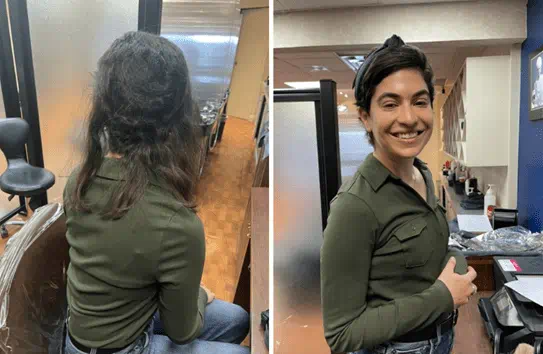
I was also using hair oils on my scalp to stimulate growth and getting regular haircuts when it was long enough. Four to 5 months post-chemo, I was getting haircuts every 6-8 weeks to get it minorly layered so my hair looked a little less awkward as it came in. When your hair comes in, some parts will be short and some could be longer because it grows from the top of your head and bottom evenly, so you have a mullet for a long time. Some hairdressers would have just cut the bottom off to make things more even, but I have an incredible hairdresser who understands hair growth and layering. I almost skipped certain phases of my hair growth because of how he layered it. That's been really important – the way it gets cut along the way can speed up the growth.
Scalp health in general is also really important. Make sure your scalp is clean, and that you’re using shampoos and conditioners to deal with a dry or oily scalp.
The first 18 months were the toughest – my hair was so thick, and it was coming in curly and almost burned at the ends from chemo. It’s hitting a long phase now – it's officially past shoulder length!

What do you want people to know about the hair loss part of cancer?
My hair has always been part of my identity. I didn't feel like myself and I didn't look like myself. That identity shift was a huge part of the cancer. But the way people feel about it is a whole spectrum. Not everybody’s hair is part of their identity.
What I always say is, you feel so awful and you're going through this horrible thing, so the physical part of it is almost linked to how you feel inside. Everything about breast cancer is physical. A lot of people lose their breasts or they're modified. You're also given medication or you're recovering from surgery. So, it's almost like there's no relief. The sickness and the treatment stays with you so long after you're done with it. Even when recovering, you might start to feel better, but you're reminded of what happened every time you look in the mirror.
I know it could sound dramatic, but the survivorship part of it is really hard. So, add in recovering physically and how long that takes. It's this layered thing because that physical part plays a role into the loss you've had as a result of having cancer. In a lot of ways, the part after treatment was harder than going through it. A lot of people say that.
Did your view of beauty and identity change after your experience with cancer?
What advice would you give to somebody going through hair loss?
Just to acknowledge how hard it is and to let yourself be sad. Having a lot of grief over the physical changes and the hair loss is also okay, and it doesn't make you vain. It's part of it. Find little things to make you feel better or more like yourself again momentarily, and zoom out into larger chunks of time to help yourself see progress. The way I got myself to feel better was thinking about the small things that lead to something bigger. When I look at that time, baking cookies or doing a Pilates workout were some things that took me out of my situation for a few minutes. It’s the same thing with hair. It grows back little by little, but being able to say, “Okay, I'm here now, but I'm going to be there in 6 months or 12 months” is really helpful.
Be very careful with hair supplements if you’re going through treatment. A lot of women write to me who are still in chemo, and they want to get started with the hair regrowth process right away. You need to be really careful when you're in active cancer treatment and even after – with all the other stuff that comes with breast cancer. There's a lot of bad supplements out there. Some of them can be good, but some of them can interact with your medication, so just be very, very cautious. Make sure you're running everything by your hospital pharmacy or your oncologist if you can. There's a lot of waiting, which is the worst, but doing it properly is really important.
I overdid it on supplements at first, and I am not sure they helped. Now, I'm trying to take a ‘less is more’ approach because I was overdoing it. Just be careful and don’t rush it. You’ll figure out what the right tools are and get through it.
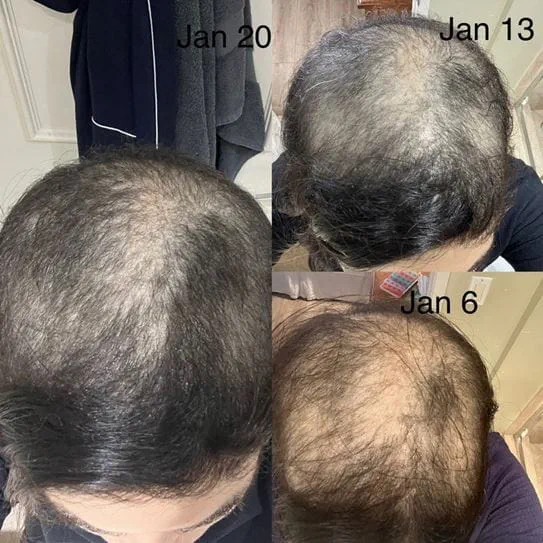
Take pictures of your hair once a week – that was my mom's advice. I started doing that 3 weeks after chemo. Every day, I was checking if it was growing and my mom said, “Let's just make Saturdays photo day. Take a photo and don't take another one until next week.” That's how I started seeing it was growing back little by little because week 1 and week 4 were 2 very different pictures. It's hard to tell when you’re checking every day, but zoom out and you'll see that progress.
Those were the first pictures I allowed of my bald head. I didn't shave my head, and I wouldn't let my friends see me. I'd only let my parents see me, and otherwise I was in a wig. It was extremely tough. But as I saw it coming in 2 weeks later, I was sending everyone collages.
How are you doing today, almost 2 years post-chemo?

You can help fund support for people affected by cancer.
Help create a future without cancer
With support from readers like you, we can continue to make a meaningful impact for people affected by cancer.
We are determined to increase survival, stop cancer before it starts, and improve lives. But we can’t do it without you.
If everyone reading this gave just $5, we could achieve our goal this month to fund the most promising research, compassionate support and transformative advocacy. Please give today because every contribution counts. Thank you.